
 Email your MP
 Letter to the editor





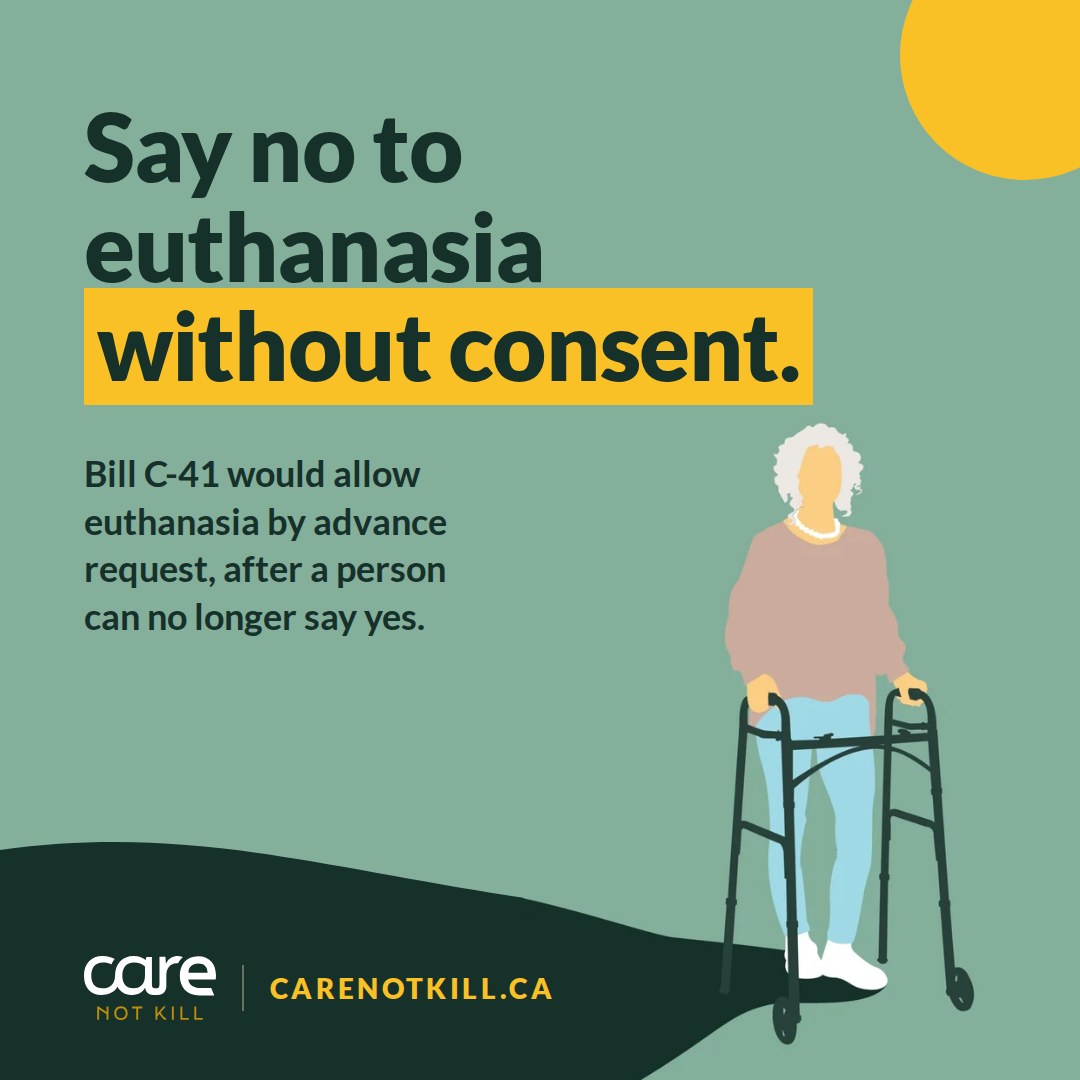
Bill C-41 would allow euthanasia by advance request for people with dementia. Take two minutes to ask your MP to say no to euthanasia without consent and, at the very least, to split the bill: #CareNotKill #BillC41
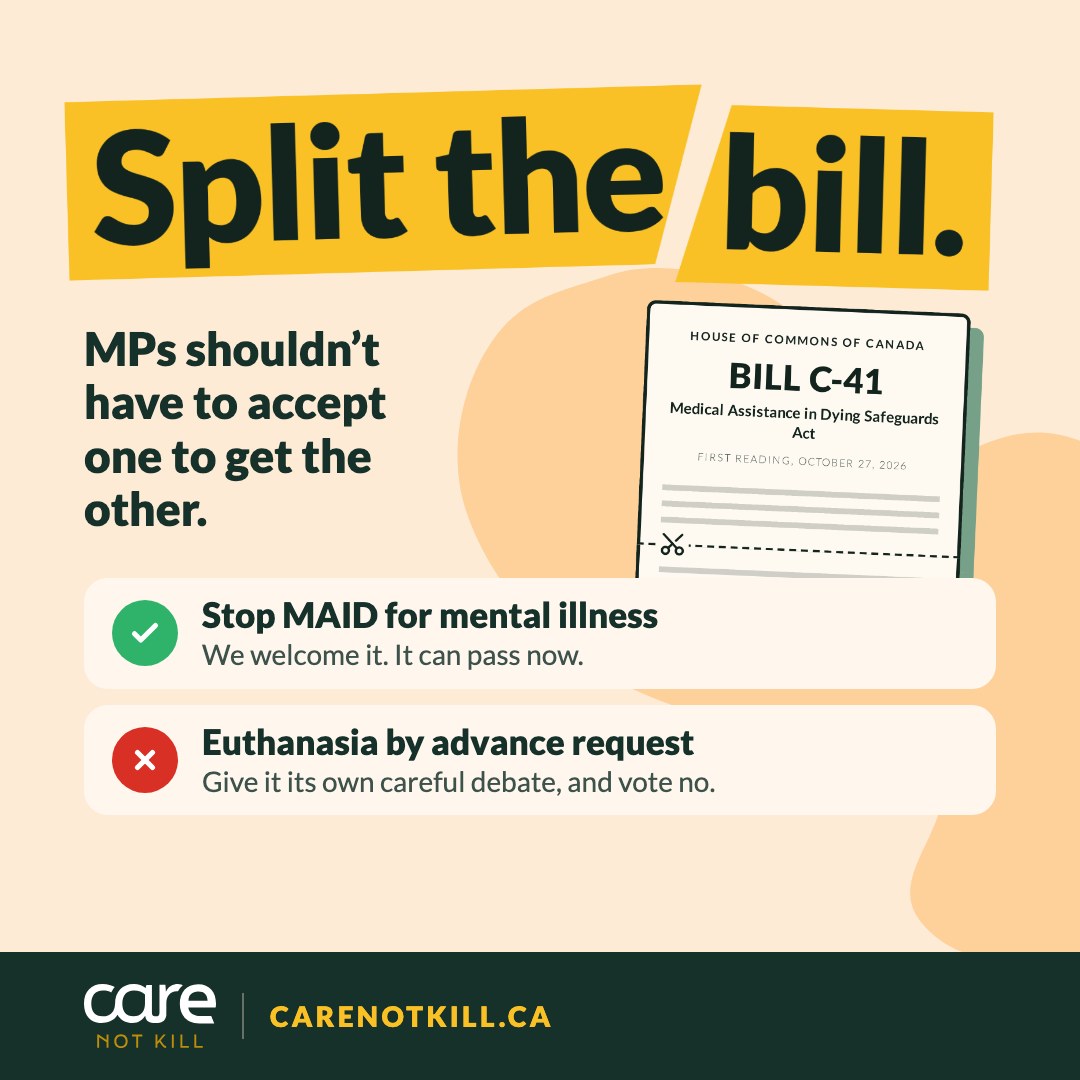
Split the bill.
Matters of life and death are not matters of partisan politics.
Introduced on October 27, 2026, Bill C-41 does two very different things at once. It’s a bill with a poison pill is a bill with a poison pill: it ties a change we welcome to one that puts people with dementia at risk, and MPs are being asked to swallow the second to get the first.
Ask your MP to reject euthanasia without consent. At the very least, split the bill: stopping MAID for mental illness can pass well ahead of the March 17, 2027 deadline, and advance requests deserve their own careful debate.
Pass this now
No MAID for mental illness
Thanks to Bill C-41, the planned expansion of euthanasia to people whose only underlying condition is mental illness would not go ahead. We welcome this change. Many Canadians have called for this, and it is good news.
Reject this
Euthanasia by advance request
Someone diagnosed with an illness like Alzheimer’s could sign a request today to be euthanized years from now, after they can no longer speak for themselves. Two practitioners would decide when the time has come. It sends a message that life with dementia isn’t worth living.
How we got here:
 2016
MAID is legalized where natural death is reasonably foreseeable.Bill C-14passed
 2021
MAID is legalized for those not nearing natural death, and MAID for mental illness alone is scheduled.Bill C-7passed
 2023–24
After strong pushback, the mental illness expansion is delayed twice.Bill C-39passedBill C-62passed
 2026
The mental illness expansion is dropped, and advance requests are added.Bill C-41proposed
Advance requests would allow euthanasia without real consent.
Today
She signs a form
Afraid of a future she has never lived, she describes the signs that she anticipates would make her want to die.
Years later
She can’t speak for herself
She may be content, or afraid, but unable to communicate that. Two practitioners decide whether she is suffering.
At the bedside
She pulls away
Bill C-41 says a refusal stops MAID. But it also says an involuntary reaction “in response to contact” doesn’t count. The doctor decides which it is.
Source: Dutch court clears doctor in landmark euthanasia trial, The Guardian, 2019.
Bill C-41 lets a doctor decide whether a frightened grandmother’s cry is a refusal or a reflex.

Plan your care.Don’t sign your life away.
Advance care planning is good and wise.It guides the care you receive at the end of life.But advance requests for euthanasia are something else entirely.
| Comparison | Advance care plan | Advance request for euthanasia |
|---|---|---|
| What happens | Passively allows death. The illness takes its natural course, with comfort care. | Actively causes death. A practitioner gives a substance to end the person’s life. |
| Cause of death | The illness. The person dies of their disease. | The procedure. The person dies of the lethal drugs they are given. |
| Who decides | Your loved ones, guided by your wishes | Two practitioners |
| Can it adapt? | Yes, to who you are now | Tied to words written years ago |
Webinar
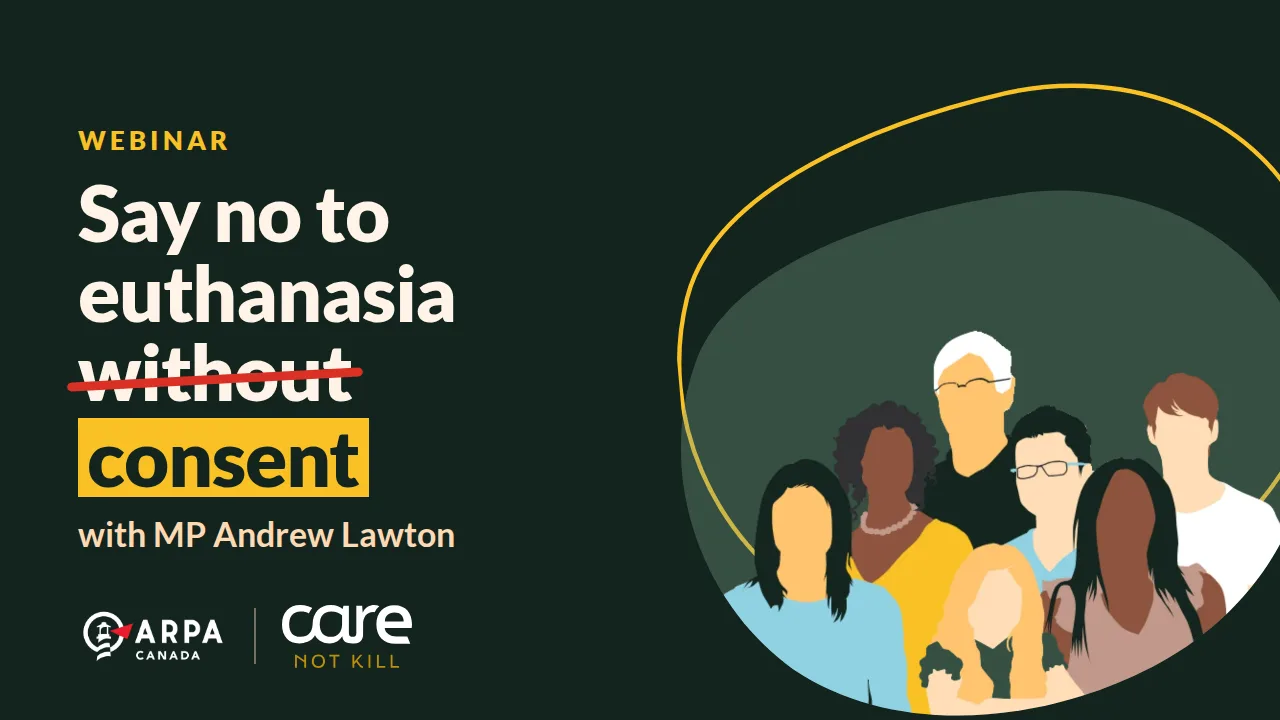
Watch the webinar with MP Andrew Lawton. Elgin—St. Thomas—London South
“Say No to Euthanasia Without Consent” explains what Bill C-41’s advance requests would mean, and how to talk to your MP about them.
What we heard at the webinar
What we heard: MP Andrew Lawton
- Two different things at once. Bill C-41 would permanently stop MAID for mental illness, but would also introduce advance requests for euthanasia.
- Split the bill. MPs should be able to vote separately on the mental illness part and the advance requests part.
- Advance requests need real scrutiny. Another MAID expansion deserves proper study and debate, not a bundled vote.
- Contact your MP. Ask them to oppose advance requests and press for the bill to be divided.
What we heard: Daniel Zekveld, ARPA Canada
- Euthanasia without consent. Advance requests would allow euthanasia for people who can no longer consent, especially people with dementia.
- No informed consent. The person can’t confirm the decision at the moment it’s carried out.
- Too much power for doctors. Doctors would gain unchecked authority to decide when a person’s life should end.
- Vulnerable lives devalued. The proposal risks devaluing people with dementia and others who can no longer speak for themselves.
- Email your MP. It’s the easiest way to act, using ARPA Canada’s CareMail.
You can make a difference!
Get involved. Write your MP or compose a letter to the editor.
Every MP, whatever their party, needs to hear from people at home.
MPs listen when constituents write in their own words.


Email your MP with CareMail
- 1Enter your name and address
- 2Choose the Bill C-41 advance requests topic
- 3Make the letter your own
- 4Preview and send
ARPA Canada never shares your information.

Write a letter to the editor with EasyLetter
- 1Enter your name and address
- 2Choose the Bill C-41 advance requests topic
- 3Make the letter your own
- 4Preview and send to your local papers
ARPA Canada never shares your information.

Watch
Why your MP (of any party) needs to hear from you
ARPA Canada explains what Bill C-41’s advance requests would mean, and why a short, personal message to your MP makes a difference.
Not sure who your MP is? Search by postal code at ourcommons.ca.

Your action toolkit
Everything you need to call, meet, and share.
Phone scriptCall your MP’s office in about two minutes
Before you call
- Find your MP and their office number at ourcommons.ca (search by postal code). The local constituency office is best.
- You’ll usually speak with a staff member or leave a voicemail. That’s normal, and your call still counts.
- Be yourself. Polite, brief, and personal is more persuasive than polished.
What to say
Hi, my name is your name, and I live in MP’s name’s riding of your riding.
I’m calling about Bill C-41. While I’m glad the bill stops MAID from expanding to people whose only condition is mental illness, I’m very concerned that it would allow advance requests for euthanasia. I believe we should protect human dignity at every age and every stage.
I’m also concerned that a person with dementia can’t confirm or withdraw a form they signed earlier once they no longer have the capacity. The bill even says an involuntary reaction “in response to contact” doesn’t necessarily count as a refusal.
Even worse, Bill C-41 ties advance requests to stopping MAID for mental illness. That puts a serious debate about human life and dignity on an artificial deadline: March 17, 2027.
I’m asking MP’s name to say no to euthanasia without consent. At the very least, the bill should be split, so advance requests get the careful debate they deserve. Stopping MAID for mental illness can be done well ahead of the March 17 deadline.
Could you tell me where MP’s name stands on advance requests? Thank you for passing my message along.
If you reach voicemail
Hi, this is your name, a constituent from your community. I’m asking MP’s name to say no to euthanasia without consent in Bill C-41. At the very least, please split the bill so advance requests get the careful debate they deserve. My number is your number. Thank you.
After you call
- Follow up in writing with CareMail. A call plus an email is twice as memorable.
- Tell ARPA Canada what you heard at [email protected]. It helps us know where MPs stand.
Meet your MPA step-by-step playbook for setting up a meeting
A short, respectful meeting with a few constituents is one of the most effective things you can do. MPs remember faces and stories.
- Request the meeting. Email your MP’s constituency office asking for 20 minutes to discuss Bill C-41. Mention that you’re a constituent and who’s coming. Use the request below.
- Gather a small group. Two to four constituents is ideal. A mix of voices helps: a caregiver of someone with dementia, a nurse or doctor, a pastor or church member. Choose one person to lead.
- Prepare together. Agree on one ask. Look up your MP’s past statements on MAID at ourcommons.ca. Decide who shares which point, and who tells a personal story.
- In the meeting (about 20 minutes). Thank them for meeting. Introduce yourselves. Make the ask. Share the three points below and one personal story. Then listen, and ask: “Will you vote against euthanasia without consent and, at the very least, support splitting Bill C-41?”
- Follow up within 24 hours. Send a thank-you email that restates the ask and anything you promised to send. Then tell ARPA Canada how it went at [email protected].
The three points to make
- Advance euthanasia requests would allow MAID without consent. An advance request removes the ability to change one’s mind after losing mental capacity.
- The safeguard that can’t work. The bill says a refusal stops MAID, but that involuntary reactions “in response to contact” don’t count. A doctor decides whether a frightened cry is a refusal or a reflex.
- Don’t put life and death on a deadline. We welcome the mental illness exclusion, and it can pass on its own well before March 17, 2027. Tying it to advance requests rushes a decision that deserves careful debate.
Meeting request email
Subject: Meeting request from constituents: Bill C-41
Dear MP’s name,
We are constituents in your community, and we would be grateful for 20 minutes of your time to discuss Bill C-41, especially its provisions on advance requests for MAID.
We would be joined by names and a word about each, e.g. a family caregiver and a local nurse. We are available dates and times and are happy to meet at your constituency office.
Thank you for considering our request.
Respectfully,
your name, address, phone
Good to know
- Be respectful and non-partisan. Thank them for anything they’ve done well, whatever their party.
- You don’t need every answer. “I’ll find out and follow up” is a great reply, and a reason to stay in touch.
- Bring a one-page summary to leave behind. ARPA Canada can provide one: ask at [email protected].
Spread the wordReady-made posts to share with family, friends and your church
The more people who understand what Bill C-41 would allow, the more MPs will hear about it. Pick a post below, copy it or tap an icon to share it on your feed, in a group chat or by email. Sharing with people who care for a parent or grandparent is especially powerful.
Share an image
Download an image and post it with one of the messages above. On a phone, tap Share to send it straight to Instagram, Facebook or a text.
More ways to make a difference

Run a billboard or bus ad
Free, print-ready Care Not Kill designs for a billboard or the side of a bus in your community. Questions, or need help? Email [email protected].

Collect signatures on a petition
A paper petition lets your MP raise your community’s concern in the House of Commons. Gather at least 25 signatures from family, friends and your church, then mail the pages to your MP. Mail to the House of Commons needs no stamp.
Questions people ask
Answers from ARPA Canada’s Bill C-41 FAQ.
Download the full FAQ (PDF)
What does Bill C-41 do?
Bill C-41, if passed, would stop the scheduled expansion of MAID for those with mental illness alone. However, it would introduce a new expansion: euthanasia by advance request.
The government could have cancelled MAID for mental illness by supporting Bill C-218, which government MPs voted down. Regardless, the government could quickly and easily pass a separate bill just to cancel MAID for mental illness. Passing Bill C-41 and permitting advance requests is not necessary in order to prevent MAID for mental illness.
What are advance requests?
Advance requests grant doctors a licence to kill patients who, at some earlier date, signed a written request to be euthanized once they reach a certain state of disability or ill health. Bill C-41 would only allow adults who have been diagnosed with an incurable, capacity-impairing illness to sign an advance request.
So, for example, a person diagnosed with dementia can, while he still has sufficient mental capacity, outline the circumstances in which he speculates that he would want to die in the future, after he can no longer consent.
Why do you call it MAID without consent if people are still asking for it?
So-called “advance consent” is not informed consent, and is really no consent at all. The person is “consenting” to circumstances he has never experienced. We know that a lot of people change their mind after requesting MAID, but once a person has lost capacity he will have no way of withdrawing the request. That is why Canada’s Supreme Court has rejected the concept of “advance consent” to sexual contact, for example.
What about the safeguards that prevent MAID if a person resists?
When someone has advanced dementia, the line between voluntary and involuntary resistance is impossible to find. Additionally, a person who has lost mental ability may not even know what is happening when the doctor begins the euthanasia process. Bill C-41 does not require a doctor to try to make the patient aware that they are about to be killed. These safeguards are inadequate. It remains up to the MAID doctor to decide when to end a patient’s life.
How do advance requests differ from advance care directives like a DNR?
Medical advance directives allow a person to clarify whether they might accept or refuse potentially life-saving interventions in situations where a decision must be made quickly. Such directives do not demand any intervention, and at most, indicate a wish to be left alone in serious medical circumstances. Advance euthanasia requests are radically different, asking a doctor to deliberately end a person’s life without current consent.
Won’t advance requests allow people with dementia to live longer instead of receiving MAID when they can still consent?
The choice for Canadians with dementia and other illnesses is not (a) MAID now; or (b) MAID later. Canadians with such illnesses are often isolated, lonely, and feel like a burden. That is often why they ask for MAID. Those who want advance requests do so out of fear for the future. But fear and social challenges must be met with care and supports, not MAID.
What’s the difference between mental illness and illness that limits mental capacity?
The term “mental illness” in Canada’s MAID law refers to illnesses such as anxiety, depression, and personality disorders, among other illnesses treated in the field of psychiatry. It does not include neurological conditions such as dementia.
Canada’s law does not permit MAID for mental illness as the sole underlying condition, though persons with physical illnesses or disabilities who suffer psychologically are eligible for MAID.
Bill C-41 would preserve the rule against MAID for mental illness, yet permit MAID for persons who are mentally disabled, provided they sign a request before they become mentally disabled.